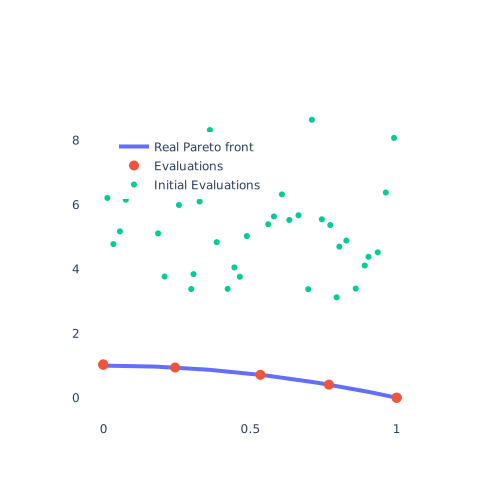
Parefs’ MOO algorithms#
Paref provides a series of ready to use generic (mainly minimization algorithms)
and problem tailored (i.e. targeting certain properties) MOO algorithms implemented in the ParefMOO interface.
In order to apply any MOO algorithm (except ExpressSearch which only needs the maximum number of iterations)
you need to initialize (or implement your own) StoppingCriteria
indicating when to stop the optimization process and call the MOO algorithm to it and
the black-box function (bbf).
from paref.moo_algorithms.multi_dimensional.find_edge_points import FindEdgePoints
from paref.moo_algorithms.stopping_criteria.max_iterations_reached import MaxIterationsReached

moo = FindEdgePoints()
stopping_criteria = MaxIterationsReached(max_iterations=10)
moo(blackbox_function=bbf, stopping_criteria=stopping_criteria)
All MOO algorithms are found within the paref.moo_algorithms module.
You can access the Pareto points fitting the properties best by calling the best_fits attribute.
Currently, Paref includes implementations of the following MOO algorithms
(illustrated by their corresponding property):
Property |
Graphic |
Algorithm |
Supported target space dimension |
Note |
|---|---|---|---|---|
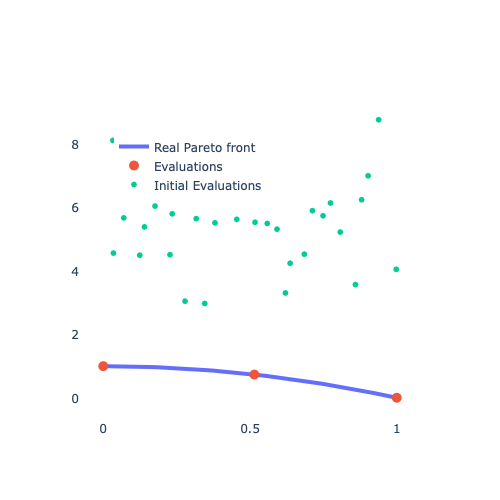
Being minima of the objectives and a real trade-off |
|
|
All |
This is a great initial search |
Being in the center of the Pareto front |
|
|
All |
|
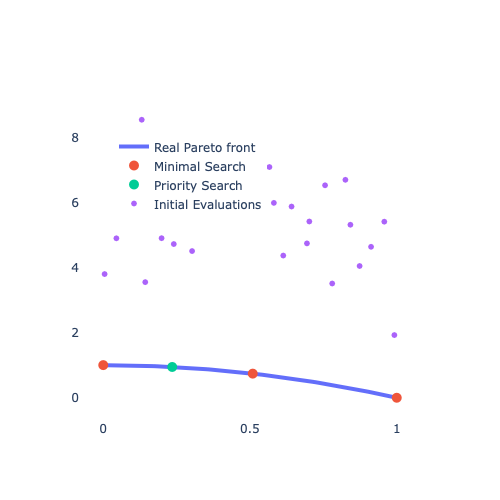
Reflecting a user defined priority of the objectives |
|
|
All |
Higher priority results in smaller target values in that component |
Being minima of the objectives |
|
|
All |
|
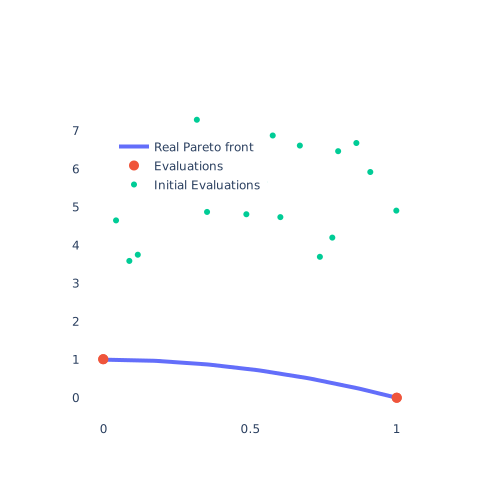
Being edge points for all objective |
|
|
All |
Edge points equal the minima in some objective only in 2 dimensions |
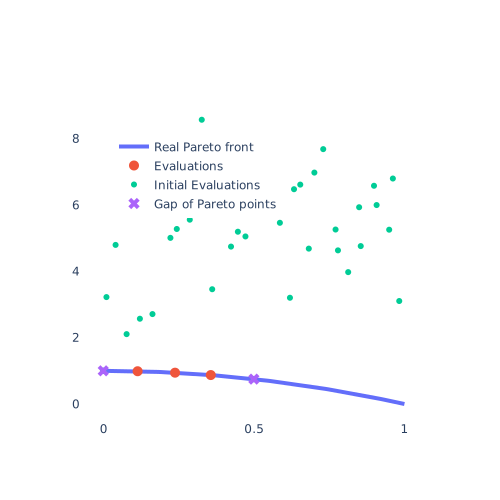
Filling the gaps of the Pareto front |
|
|
2 |
|
Being evenly distributed |
|
|
2 |
|
Finding a minimum with minimum number of iterations |
|
1 |
Apply to expensive bbf |
|
Finding a minimum with high number of iterations (for cheap bbf) |
|
1 |
Apply to cheap bbf |